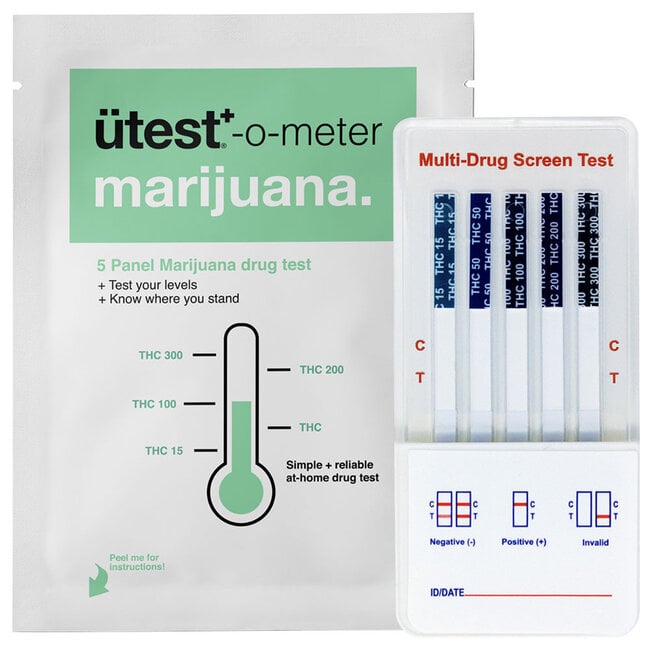
The uTest O-Meter is a one-step, easy-to-use, self-testing device designed for the detection of THC (Marijuana) at five different levels (15/50/100/200/300ng) in urine.
Features of the uTest O-Meter:
UTest-O-Meter 5 Level of THC Detection is a multi-level marijuana screening test designed to provide more detailed information about THC metabolite concentrations than a conventional single-cutoff test. Featuring five detection levels, this product helps users understand how their sample compares with different screening thresholds. It is intended for preliminary testing and should not be considered a precise laboratory measurement of THC concentration or proof of current impairment. Customers in the United States and Canada should follow the manufacturer's instructions for accurate result interpretation.
UTest-O-Meter is a multi-level THC screening product designed to evaluate a sample against five detection thresholds.
It means the test evaluates THC-related compounds against five cutoff concentrations rather than a single screening threshold.
The exact five cutoff values should be confirmed on the manufacturer's packaging or instructions for this specific model.
Urine marijuana screening tests commonly target THC-COOH, a metabolite of THC. The exact target analyte should be verified against the product documentation.
It is associated with multi-level THC screening, but the exact specimen requirements should be confirmed from the manufacturer's instructions.
A conventional THC test typically provides a result at one cutoff. UTest-O-Meter uses five detection levels to provide a more detailed preliminary screening profile.
No. A multi-level screening test can indicate results relative to its cutoff thresholds, but it does not replace quantitative laboratory analysis.
It screens for a specified THC-related analyte. A positive result may indicate exposure but does not establish when cannabis was used or whether someone is currently impaired.
Detection depends on exposure history, specimen type, individual metabolism, test sensitivity, and time since exposure.
Accuracy depends on the manufacturer's validated performance, proper storage, sample collection, and correct interpretation. Exact performance statistics have not been independently verified.
Yes. Preliminary drug-screening tests can produce false-positive results, and unexpected positives should be confirmed through an appropriate laboratory method.
Yes. A negative result may occur when the target analyte is below the relevant cutoff or when other testing limitations affect detection.
No. THC metabolite detection does not necessarily establish current cannabis impairment.
Results from repeated tests may indicate changes in which thresholds are crossed, but variations in sample concentration and other factors mean they cannot reliably establish the rate of THC elimination.
Detection windows vary depending on specimen type, cannabis exposure history, metabolism, and testing method.
The exact result-reading time should be confirmed in the manufacturer's instructions.
Rapid drug-screening devices are generally single-use. Confirm the instructions for this specific model.
Check the packaging for the expiration date and lot number. Expired tests may produce unreliable results.
Availability depends on retailer inventory and applicable federal, state, and local requirements.
Canadian availability depends on retailer inventory, import eligibility, product classification, and applicable regulations.
A five-level THC drug test evaluates a sample against five screening cutoffs, providing more information about the concentration range of its target analyte than a single-cutoff test.
It provides additional cutoff comparisons, which may be useful for preliminary screening. Whether it is more appropriate depends on the testing purpose, accuracy requirements, and manufacturer specifications.
No. It cannot determine the total amount of THC in the body or provide an exact laboratory-confirmed concentration.
No. Screening results cannot reliably identify the exact time of cannabis use.
It may be suitable for home screening if the manufacturer designates it for that purpose. Follow the product instructions and applicable requirements.
Suitability depends on workplace policies, applicable Canadian requirements, and whether the test meets the necessary testing standards.
No. It generally means the target analyte was not detected at or above the test's specified cutoffs, assuming the test was performed correctly.
Some CBD products contain THC, and exposure to those products may lead to detectable THC metabolites.
Regulatory authorization has not been independently verified for this exact product. Check manufacturer documentation and official regulatory records.
Seek confirmation from an appropriate accredited laboratory before making significant medical, employment, or legal decisions.
| Feature | Information |
|---|---|
| Product Name | UTest-O-Meter 5 Level of THC Detection |
| Product Category | Multi-level marijuana drug-screening test |
| Number of Detection Levels | 5 |
| Target Substance | THC-related analyte; verify exact metabolite |
| Exact Cutoff Values | Manufacturer confirmation required |
| Specimen Type | Manufacturer confirmation required |
| Test Format | Manufacturer confirmation required |
| Result Time | Manufacturer confirmation required |
| Reusability | Manufacturer confirmation required |
| Package Contents | Manufacturer confirmation required |
| Regulatory Status | Not independently verified |
| Markets Addressed | United States and Canada |
Follow the manufacturer's instructions for sample collection, testing, storage, and result interpretation.
UTest-O-Meter provides preliminary screening information rather than an exact quantitative laboratory measurement. Results should not be used to determine current impairment or establish the precise timing of cannabis exposure.
Unexpected positive results should be confirmed using an appropriate laboratory method. A negative result does not guarantee the complete absence of THC-related compounds.
UTest-O-Meter 5 Level of THC Detection offers a multi-threshold approach to preliminary marijuana screening, allowing users to compare results across five detection levels. It provides additional screening information compared with a conventional single-cutoff test while remaining subject to the limitations of rapid drug testing.
Customers in the USA and Canada should verify the exact cutoff values, specimen requirements, and regulatory information before use.